Content Warning: Book Spoilers Ahead. An Ethical Guide to Murder by Jenny Morris deals with themes of suicide, abuse, violence, murder, depression, and substance abuse. This review will touch on these topics. Take care before reading.
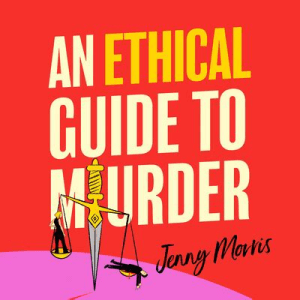
Sometimes justice is best found through living your life fully, celebrating the good and atoning for the wrong.
It all started on New Year’s Day in a Barnes & Noble. I was on a No-Buy challenge, but I went to Barnes & Noble to use it as a third space to watch my K-drama. It then occurred to me that just because I am on a No-Buy challenge doesn’t mean I cannot explore the books here. Feeling whimsical, I chose a random genre: horror. I got up and began perusing the shelves, but anything pure horror failed to capture my attention. I slightly expanded the limits of my search to include thrillers and ran across this title: An Ethical Guide to Murder. Ethics and murder? What an oxymoron. I quickly picked up the book to read the bio. I was hooked.
Contemplating the ethics of life and death took me back to the days in my healthcare ethics class in college, where we heavily discussed the principles of doctor-assisted suicide. A book that explored such ethics from the perspective of a seemingly benevolent murderer seemed fascinating, and I quickly began reading. I never thought I would be invested in a thriller book, but here I was, three chapters in and looking for a copy of this book in my online library. It was all delectably No-Buy-approved.
Summary
The book begins with Thea, our protagonist, on the day of her best friend Ruth’s death. When Thea touches Ruth, she discovers she has the power to see when people will die. Caught in the grip of denial and bargaining, she inadvertently discovers she can reverse Ruth’s fate. She quickly learns, however, that her power comes with a devastating cost: the only way to give life to someone is by taking it from another.
This revelation sends Thea on a vigilante serial killer spree where she seeks out justice for the world’s wrongdoings, ultimately murdering eleven people. Never satisfied and increasingly consumed by her power, she begins to feel as though it is controlling her. Determined to make amends, she seeks out those whose lives have been forever altered by her victims’ deaths.
In the end, Thea eventually gives her own life so a young girl can spend more time with her father, a detective who was feverishly and impossibly trying to connect Thea to her murder victims.
Analysis
Thea’s journey leaves readers contemplating their own morality. As a character, she is intricately flawed yet likable. She is juxtaposed with her best friend Ruth’s angelic moral purity and her boyfriend’s corrosive, morally pathetic nature.
I found it honest and raw to see Thea aim for a career she thought would bring her peace and value, being a lawyer. Her slow realization that she lacks the patience, maturity, and attention to detail the role demands felt both relatable and cathartic. It resonated with anyone who has mourned the time and effort invested in a dream they ultimately weren’t meant to achieve.
The plot is incredibly satisfying as Thea’s actions result in unforeseen consequences that teach her the same lesson as her darker deeds: no good deed goes unpunished. When she thinks she is saving someone, she inadvertently catapults their lives into hell. Rather than root for her, all I could do was watch Thea work from the sidelines in horrified fascination.
Jenny Morris does a great job of making a likable, flawed protagonist. Considering the author has her doctorate in psychology, I would be fascinated to know what inspired her to write this book and how her background informed the character’s choices.
The entire novel can be read as a metaphor for addiction: an irresistible vice that enters Thea’s life, spirals beyond her control, and persists despite her attempts to deny or manage it. The book also explores heavy themes of depression and suicide, weaving them naturally into Thea’s emotional journey. Her denial of her power gradually gives way to compulsive use, creating an unsatisfying cycle that only deepens her desperation and sends her life into a downward spiral.
When Thea decides to confront her power-trip, she starts attending AA meetings, where she finds kinship and community. We begin to see Thea truly face and accept the consequences of her actions, giving readers a satisfying hope for her future and recovery. Sadly, this is all dropped when, at an AA meeting, Thea gets into a furious altercation with an attendee. Emboldened by her ability to murder him on a whim, Thea pushes and provokes him to be physical with her. She ends up taking his life and quickly (and guiltily) placing it back before he has the time to truly pass on. After this altercation, Thea never returns to AA. Instead, she comes to see herself as a monster and decides the only way to find redemption is to sacrifice her own life to save a dying girl.
Reflections
The book takes readers on a moral journey, asking who deserves to live and die while exploring what it means to be a recovering addict and how recovery can offer hope. Despite the profound ethical foundation the book creates, Thea’s choice feels like an easy out and like the wrong message to those struggling with addiction.
In the book, Thea compares herself to an alcoholic, noting that while an addict can relapse and still have the chance to recover, her own “relapses” carry irreversible consequences because someone dies. She uses this thinking to justify her suicidal choice.
Thea catastrophizes her own life, downplaying others’ pain and suffering when she compares it to her “moral dilemma of choosing life and death every day.” It is one of the most frustrating parts of her character, and it is sad and unsatisfying to see this self-demonization be her downfall. Thea committed suicide because she couldn’t come to terms with her power, learn how to address her anger, and deal with the aftermath and guilt of her murders. In the end, I was left with pity for a character whose story and recovery was cut short.
While the premise of Thea’s death is frustrating in terms of plot and character development, the way it is written is beautiful and heartwarming. Thea gets to see her grandfather into his final days, confess her wrongdoings to those affected, and, on her final day, reunites with Ruth. While Ruth remains unforgiving of Thea’s actions, she shows grace in giving her one final day of unadulterated joy. The sequence feels like a testament to true love, as well as the beauty and strength of friendship. By beginning with Thea at Ruth’s death and mirroring that moment in the finale, the book makes a strong artistic choice that brings the story full circle.
Overall, this book had me enthralled. We see how “ethical” does not equate “moral” or “just”. We also get to see how loving and well-intentioned actions can still produce negative outcomes. Ultimately, readers understand that life is never in our control, no matter how badly we try. Sometimes justice is best found through living your life fully, celebrating the good and atoning for the wrong.
 To Be Natalia Santiago
Leave a comment